Why Globally Mobile Families Often Feel Emotionally Fragmented
The same institutional access behind these programmes is set out in the Selected Institutional Portfolio.
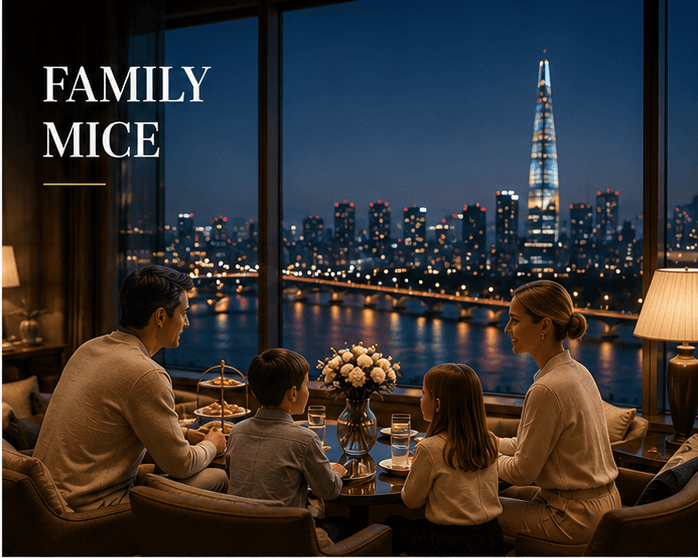
→ Family MICE, human-centered Korea experiences
Over time, while living and working between Seoul, Paris, Hong Kong, and multicultural international environments, I began observing something increasingly common among globally mobile families.
Many families were constantly moving across borders, cultures, schools, digital environments, and international lifestyles.
Yet emotionally, many also seemed increasingly fragmented beneath the surface.
Parents often carried invisible layers of:
career pressure,
financial responsibility,
educational planning,
relocation fatigue,
wellness concerns,
and emotional exhaustion created by modern accelerated life.
Teenagers, meanwhile, were growing up inside:
social media,
gaming culture,
K-pop,
digital ecosystems,
online identity formation,
and constantly evolving virtual environments.
And although families were physically together, psychologically many seemed elsewhere.
Everyone was connected digitally.
Yet often emotionally disconnected.
I began noticing this pattern repeatedly while observing internationally educated households, multicultural families, entrepreneurial parents, and globally mobile professionals.
Schedules became increasingly compressed.
Conversations became fragmented.
Reflection became rare.
And meaningful emotional presence often became replaced by speed, logistics, and overstimulation.
Ironically, modern global mobility created extraordinary access to the world while simultaneously making emotional grounding more difficult for many families.
Perhaps this is partly why so many globally minded parents became interested in Korea.
Teenagers were naturally attracted to:
K-pop,
fashion,
gaming,
creator culture,
beauty trends,
and Korea’s highly visual digital ecosystems.
Parents, however, were often fascinated by very different layers beneath the surface:
education,
entrepreneurship,
wellness,
innovation,
gastronomy,
business culture,
and Korea’s emotional and societal transformation.
And perhaps both generations were searching for different forms of meaning through the same environment.
Over time, I started questioning whether traditional family programs truly created meaningful connection.
Many experiences felt overly structured.
Overly rushed.
Overly consumption-driven.
Families moved together physically,
but often experienced destinations separately psychologically.
This realization gradually became one of the philosophical foundations behind KP Nalgae and the evolving concept of Family MICE & Human-Centered Korea Experiences.
Not simply organizing tourism schedules.
But carefully curating emotionally intelligent ecosystems where:
teenagers,
parents,
entrepreneurs,
and multicultural families
may experience Korea through different lenses while still remaining meaningfully connected together.
Because perhaps meaningful family experiences do not come from forcing everyone into identical rhythms.
Perhaps deeper connection emerges when individuals are also allowed:
space,
reflection,
personal curiosity,
emotional pacing,
and meaningful forms of individual fulfillment.
Teenagers may connect through Korean youth culture, esports, creativity, and digital ecosystems.
Parents may discover inspiration through entrepreneurship, wellness, education, gastronomy, innovation, and cultural observation.
Others may simply seek reflection, conversation, slower pacing, and emotional grounding.
And perhaps in the age of AI and digital acceleration, globally mobile families are increasingly searching not only for destinations,
but for experiences that still feel deeply human.
→ Read more about Family MICE and human-centered Korea experiences.
Author
Kary Sungmi Park — Paris-based cross-cultural strategist and founder of KP Nalgae.
Related Perspectives
• The Hidden Emotional Gap Inside International Families
• Modern Families Are Together, But Often Psychologically Elsewhere
• In the Age of AI, Families Are Searching for Human Connection