Why Traditional Family Experiences Often Fail
The same institutional access behind these programmes is set out in the Selected Institutional Portfolio.
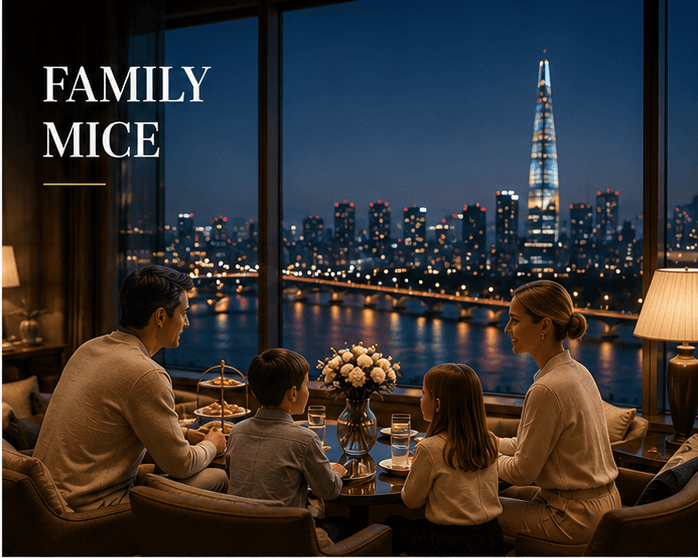
→ Family MICE, human-centered Korea experiences
Personal Reflections Between Paris, Seoul, Hong Kong, and Global Families
After years between Korea, Hong Kong, Europe, and now Paris, I started questioning the way family experiences are designed. The question did not come from my work. It came from my own family.
Growing Up Between Cultures
I went to boarding school in Canada as a teenager and grew up fairly independently from a young age. After university I joined Korean Air’s headquarters, on a marketing task force, during a period when Korea was rapidly expanding globally. The work kept me moving between cities and cultures, and I built a multicultural career and a multicultural way of seeing things, both quite young.
Hong Kong came next. I spent years there among international entrepreneurs, executives and creatives. It exposed me not only to different industries, but also to very different ways of thinking, communicating and defining success.
Somewhere in the middle of that, I married and built a multicultural family of my own.
The Contradiction Inside Modern Family Experiences
Family life is what made me question family experiences.
The destinations were beautiful. The schedules were carefully planned. And still, everyone on the trip seemed to want something different from it.
Parents wanted rest and a real conversation. Teenagers wanted independence, stimulation, and space to be themselves. Younger children ran on their own rhythms entirely. Even within loving families, fulfillment rarely happened in the same way for everyone at the same time.
I saw the same pattern in the internationally mobile families around me. They were traveling constantly, yet often becoming emotionally fragmented. Parents exhausted. Teenagers overstimulated. Many people physically together while psychologically elsewhere.
That contradiction stayed with me.
Why Teenagers and Parents Experience Korea Differently
Later, while facilitating Korea-Europe collaborations professionally, I noticed something specific about Korea.
The parents I met were curious about Korean entrepreneurship, the education system, wellness culture, food, and how a country changes that fast. Their teenagers were interested in K-pop, esports, Korean digital culture, beauty, and contemporary Seoul.
Both generations were fascinated by Korea, for entirely different reasons.
I understood the teenagers. Traveling with my own parents at that age, I wanted room to meet a place on my own terms rather than inside somebody else’s schedule.
Beyond Conventional Family Programs
That is where the Family MICE philosophy I am developing through KP Nalgae started, and the wider idea of Human-Centered Korea Experiences.
Perhaps meaningful family experiences do not come from forcing everyone into the same structure. Perhaps deeper connection happens when each individual is also allowed to engage meaningfully through their own pace, interests, curiosity and perspective.
So rather than placing everyone inside one identical itinerary, I became more interested in carefully curating immersive ecosystems where different generations could experience Korea through their own lenses while still remaining meaningfully connected together.
Korea Beyond the Surface
Korea is layered enough to support that.
Some people meet it through youth culture and digital energy. Others through wellness, education, creativity, entrepreneurship, gastronomy or cultural reflection. Some come simply to look at a different model of modern life and think about their own.
The strongest responses so far have come from multicultural families, internationally educated households, entrepreneurial parents, and globally mobile individuals.
Perhaps modern families today are no longer searching only for activities or consumption-driven travel. Perhaps they are searching for reflection, emotional resonance, cultural intelligence and more human forms of connection.
And perhaps in the age of AI, experiences that still feel deeply human may become even more valuable. That is one of the directions I hope to continue exploring through KP Nalgae.
→ Read more about Family MICE and human-centered Korea experiences.
Author
Kary Sungmi Park — Paris-based cross-cultural strategist and founder of KP Nalgae.