The Hidden Emotional Gap Inside International Families
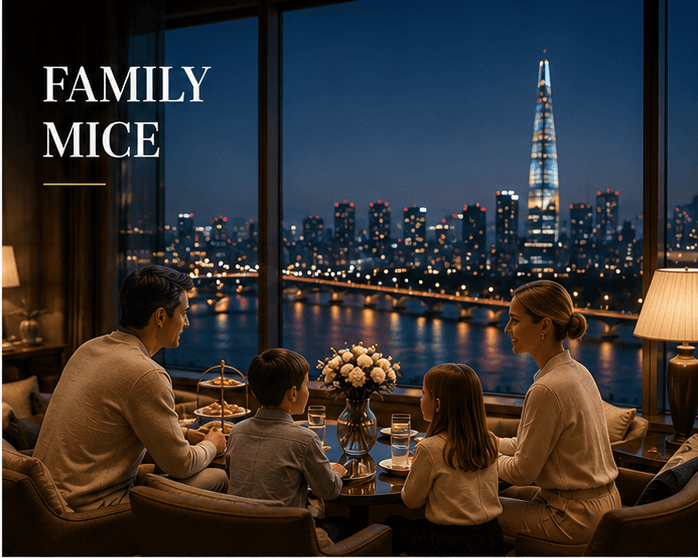
The same institutional access behind these programmes is set out in the Selected Institutional Portfolio.
→ Family MICE, human-centered Korea experiences
Over time, while living and working between Seoul, Paris, Hong Kong, and multicultural international environments, I began observing something surprisingly common inside many internationally mobile families.
From the outside, many families appeared highly connected, globally experienced, and socially successful.
Children attended international schools.
Parents navigated global careers.
Families moved fluidly between cultures, countries, airports, digital environments, and international lifestyles.
Yet beneath the surface, many quietly carried invisible emotional gaps.
Not necessarily dramatic conflict.
But subtle forms of emotional distance that gradually emerged through accelerated modern life.
Parents often carried:
career pressure,
financial responsibility,
relocation fatigue,
identity transition,
and emotional exhaustion created by constant adaptation.
Teenagers often navigated:
social media,
online identity formation,
peer comparison,
multicultural identity questions,
digital overstimulation,
and emotional uncertainty beneath highly connected digital environments.
And because everyone adapted differently, emotional rhythms inside families often became increasingly fragmented over time.
Some family members desired movement and stimulation.
Others quietly desired rest and grounding.
Some sought achievement and expansion.
Others sought emotional safety and belonging.
And often, despite loving one another deeply, family members no longer experienced life emotionally at the same pace.
Perhaps this is one of the quiet realities shaping many globally mobile households today.
Over time, I began questioning whether traditional family experiences truly created meaningful emotional reconnection.
Many experiences remained overly structured.
Overly rushed.
Overly consumption-driven.
Families traveled together physically,
yet often processed experiences internally and separately.
This realization gradually became one of the philosophical foundations behind KP Nalgae and the evolving concept of Family MICE & Human-Centered Korea Experiences.
Not simply organizing itineraries.
But carefully curating immersive ecosystems where:
teenagers,
parents,
entrepreneurs,
and multicultural families
may experience Korea through different emotional lenses while still remaining meaningfully connected together.
Because perhaps meaningful family experiences today require more than movement alone.
Perhaps they increasingly require:
reflection,
conversation,
slower pacing,
emotional intelligence,
human observation,
and space for individual curiosity.
Teenagers may connect emotionally through Korean youth culture, gaming, creativity, and digital ecosystems.
Parents may discover inspiration through entrepreneurship, wellness, education, gastronomy, innovation, and cultural reflection.
Others may simply seek emotional grounding and meaningful human interaction.
And perhaps in the age of AI and accelerated global life, the experiences families value most may increasingly become the ones that still feel emotionally real.
→ Read more about Family MICE and human-centered Korea experiences.
Author
Kary Sungmi Park — Paris-based cross-cultural strategist and founder of KP Nalgae.
Related Perspectives
• Why Traditional Family Experiences Often Fail
• Why Globally Mobile Families Often Feel Emotionally Fragmented
• Modern Families Are Together, But Often Psychologically Elsewhere