Why Teenagers and Parents Experience Travel Differently
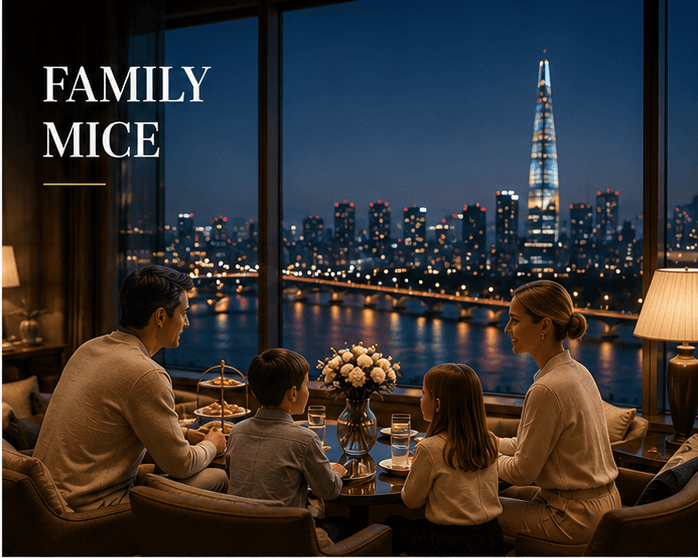
→ Family MICE, human-centered Korea experiences
Over time, while observing internationally minded families across different countries and cultures, I began noticing something increasingly important.
Teenagers and parents often experience travel completely differently.
Even when physically sharing the same itinerary, emotionally they are frequently searching for entirely different forms of meaning.
Teenagers often seek:
freedom,
identity,
creativity,
novelty,
social stimulation,
digital engagement,
and emotional excitement.
Parents, meanwhile, frequently seek:
reflection,
rest,
cultural understanding,
wellness,
education,
emotional reassurance,
and meaningful family connection.
And perhaps this difference is completely natural.
I remember feeling something similar myself while traveling with my own parents during my teenage years.
At that age, I also desired space to experience the world through my own emotional rhythm and curiosity.
Perhaps modern family experiences become difficult when everyone is expected to engage emotionally in identical ways.
Why Teenagers and Parents Experience Korea Differently
Over time, while living and working between Seoul, Paris, Hong Kong, and multicultural global environments, I observed how traditional travel structures often unintentionally intensified these differences.
Schedules became crowded.
Movement became constant.
Activities became generalized.
Teenagers sometimes became emotionally overstimulated.
Parents sometimes became physically and emotionally exhausted.
And meaningful emotional connection often became secondary to logistics and rapid consumption of destinations.
Korea itself creates an especially interesting environment for these generational contrasts.
Teenagers are naturally drawn toward:
K-pop,
gaming,
fashion,
creator ecosystems,
beauty culture,
and Korea’s fast-moving digital aesthetics.
Parents often become interested in:
education,
wellness,
entrepreneurship,
innovation,
gastronomy,
design,
and broader cultural transformation.
Why Flexibility Matters in Family MICE
And perhaps meaningful family immersion begins when both generations are allowed to experience Korea differently while still remaining emotionally connected together.
This realization gradually became one of the philosophical foundations behind KP Nalgae and the evolving concept of Family MICE & Human-Centered Korea Experiences.
Not simply organizing tourism schedules.
But carefully curating emotionally intelligent ecosystems where:
teenagers,
parents,
entrepreneurs,
and multicultural families
may move through Korea with different rhythms, curiosities, and emotional perspectives while still sharing meaningful moments together.
Because perhaps meaningful family experiences today are no longer about forcing identical participation.
Perhaps they increasingly require:
flexibility,
reflection,
individual curiosity,
human observation,
emotional pacing,
and deeper cultural understanding.
And perhaps in the age of accelerated global life, emotionally intelligent travel itself is becoming one of the most valuable forms of human connection.
→ Read more about Family MICE and human-centered Korea experiences.
Author
Kary Sungmi Park — Paris-based cross-cultural strategist and founder of KP Nalgae.
Related Perspective
Family MICE & Human-Centered Korea Experiences
An evolving ecosystem exploring how globally minded families, teenagers, entrepreneurs, and multicultural generations may experience Korea through different lenses while remaining meaningfully connected together.