Modern Families Are Together, But Often Psychologically Elsewhere
The same institutional access behind these programmes is set out in the Selected Institutional Portfolio.
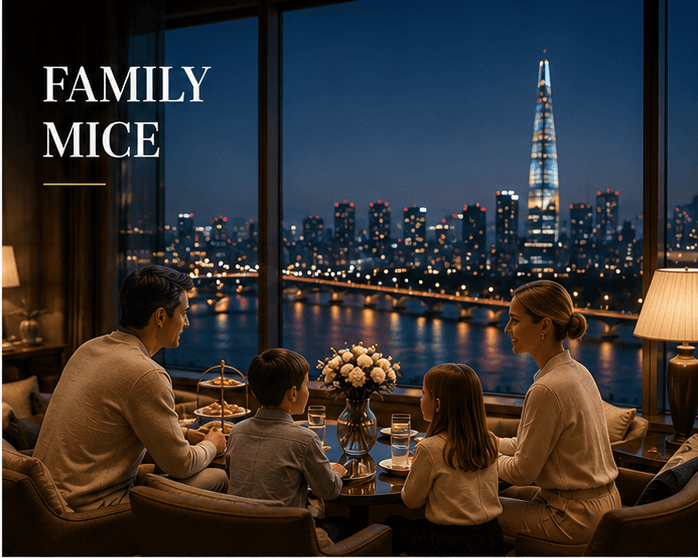
→ Family MICE, human-centered Korea experiences
Personal Reflections Between Seoul, Paris, and Contemporary Family Life
Families today often spend significant amounts of time physically together, yet psychologically many seem increasingly elsewhere. That quiet contradiction is what I kept noticing in modern global family life.
What Each Generation Is Carrying
Parents are carrying career pressure, money worries, constant communication, school planning, wellness fatigue, and the general overstimulation of a life running at speed.
Teenagers are living inside social media, gaming, creator culture, K-pop, streaming, digital ecosystems, and online identities that keep changing.
And because modern digital systems continuously compete for human attention, emotional presence itself increasingly becomes fragmented. Conversations get shorter. Focus splits. Silence gets filled with screens. Even during travel, many people remain partially connected somewhere else psychologically.
Why Speed Does Not Create Connection
Living and working between Seoul, Paris, Hong Kong and other multicultural environments, I noticed how many globally mobile families quietly felt emotionally exhausted beneath the surface. The calendar was dense. The movement was constant. Experiences were consumed quickly.
Connection does not come from speed. It comes from slowness, reflection, conversation, emotional pacing, and intentional human presence. Perhaps this is partly why many globally minded families increasingly search for experiences that feel more emotionally grounding and human-centered.
Korea Reflects the Same Tensions
Korea carries the same pressures shaping modern life everywhere: hyperconnected, digitally accelerated, creative, competitive, emotionally layered, and constantly adapting.
Teenagers connect to it through K-pop, gaming, fashion, creator ecosystems and Korean youth culture. Parents connect through education, entrepreneurship, wellness, innovation, gastronomy, business culture and social transformation.
Meaningful family experiences happen when both generations are allowed to engage on their own terms and still share the same moments.
That became one of the philosophical foundations behind KP Nalgae and the evolving concept of Family MICE and Human-Centered Korea Experiences. Not itineraries and fast-moving tourism schedules, but carefully curating immersive ecosystems where teenagers, parents, entrepreneurs and multicultural families can reconnect through culture, reflection, conversation, human observation, human connection and emotionally intelligent pacing.
Perhaps in the age of AI and digital acceleration, emotional presence is becoming one of the rarest forms of luxury. Globally minded families are not only looking for destinations any more. They are looking for experiences that still feel deeply human.
→ Read more about Family MICE and human-centered Korea experiences.
Author
Kary Sungmi Park — Paris-based cross-cultural strategist and founder of KP Nalgae.
Related Perspectives
• Why Globally Mobile Families Often Feel Emotionally Fragmented
• The Hidden Emotional Gap Inside International Families
• In the Age of AI, Families Are Searching for Human Connection