In the Age of AI, Families Are Searching for Human Connection
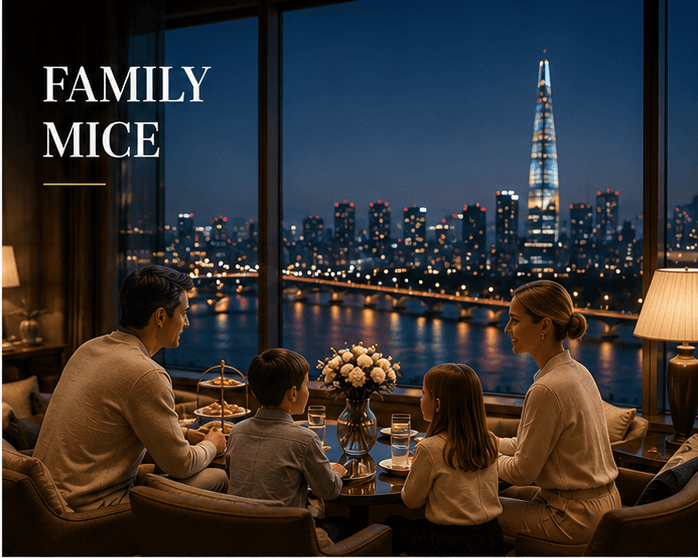
→ Family MICE, human-centered Korea experiences
The world is entering an era of extraordinary acceleration.
Artificial intelligence generates information instantly.
Digital systems automate communication.
Algorithms shape attention.
Content moves continuously across platforms and screens.
Modern life has never been more connected technologically.
Yet emotionally, many people quietly feel increasingly disconnected.
Over time, while living and working between Seoul, Paris, Hong Kong, and multicultural international environments, I began observing how globally minded families were increasingly searching for something deeply human again.
Not necessarily bigger experiences.
Not necessarily more luxurious experiences.
But experiences that create:
emotional resonance,
reflection,
presence,
conversation,
human observation,
and meaningful connection.
Why Human Connection Is Becoming Increasingly Valuable
Parents often navigate:
career uncertainty,
financial pressure,
global mobility,
educational decisions,
wellness concerns,
and emotional fatigue created by accelerated modern life.
Teenagers grow up immersed inside:
social media,
creator culture,
gaming,
K-pop,
digital ecosystems,
streaming platforms,
and constantly evolving online identities.
And because digital systems continuously compete for human attention, many families now spend significant amounts of time physically together while remaining psychologically elsewhere.
Korea as a Reflection of Contemporary Digital Society
Perhaps this is partly why Korea has become such a fascinating place for globally minded families today.
Korea itself reflects many of the tensions shaping the future of modern society.
It is:
hyperconnected,
creative,
competitive,
highly visual,
digitally accelerated,
emotionally layered,
and constantly evolving.
Teenagers often connect emotionally through:
K-pop,
gaming,
fashion,
creator ecosystems,
and Korean youth culture.
Parents frequently become interested in:
education,
entrepreneurship,
wellness,
innovation,
gastronomy,
business ecosystems,
and broader cultural transformation.
And perhaps beneath these different interests, both generations are ultimately searching for something similar:
meaning,
identity,
emotional belonging,
and genuine human connection.
Why Reflection Matters in Family MICE
Traditional tourism structures rarely create enough emotional space for these deeper forms of connection.
Schedules become rushed.
Experiences become rapidly consumed.
Movement becomes constant.
But meaningful human connection rarely emerges through speed alone.
Perhaps meaningful connection increasingly requires:
slowness,
reflection,
conversation,
emotional pacing,
and intentional human presence.
This realization gradually became one of the philosophical foundations behind KP Nalgae and the evolving concept of Family MICE & Human-Centered Korea Experiences.
Not simply organizing itineraries.
But carefully curating immersive ecosystems where:
teenagers,
parents,
entrepreneurs,
and multicultural families
may reconnect through:
culture,
reflection,
human observation,
conversation,
and emotionally intelligent pacing.
Because perhaps in the age of AI, the experiences people value most will no longer simply be based on information or efficiency.
AI may automate speed.
But human experiences still shape memory.
Conversation still shapes connection.
Observation still shapes perspective.
And emotional resonance still shapes meaning.
And perhaps this is why globally minded families increasingly search not simply for destinations,
but for experiences that still feel deeply human.
Author
Kary Sungmi Park — Paris-based cross-cultural strategist and founder of KP Nalgae.
Related Perspectives
• Why Reflection May Become the New Luxury
• The Future of Human-Centered Family Experiences
• Modern Families Are Together, But Often Psychologically Elsewhere