The Future of Human-Centered Family Experiences
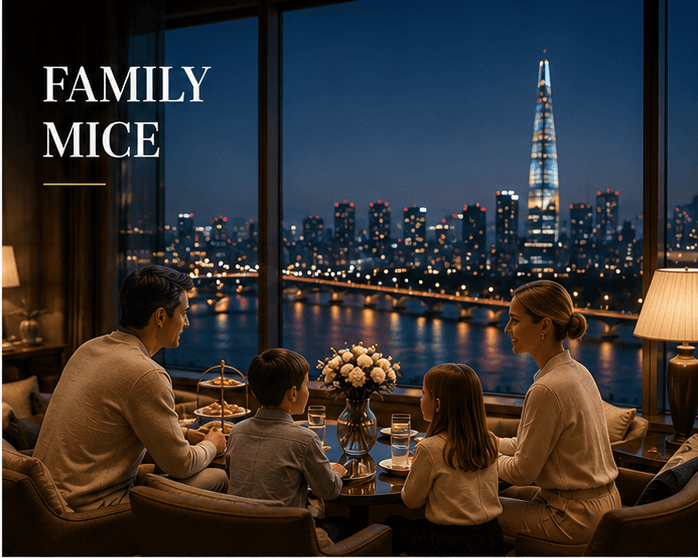
The same institutional access behind these programmes is set out in the Selected Institutional Portfolio.
→ Family MICE, human-centered Korea experiences
Modern global family life is evolving rapidly.
Technology accelerates communication.
Digital systems shape attention.
Artificial intelligence transforms how people work, learn, consume, and interact.
Families today navigate increasingly complex emotional realities:
global mobility,
digital overstimulation,
educational pressure,
career uncertainty,
multicultural identity,
constantly shifting social environments.
And perhaps because modern life moves so quickly, many people are quietly beginning to search for something very different.
Not necessarily more stimulation.
But more meaningful human experience.
Why Human-Centered Experiences Are Becoming More Valuable
Over time, while living and working between Seoul, Paris, Hong Kong, and multicultural international environments, I began observing how globally minded families increasingly valued:
reflection,
emotional connection,
presence,
conversation,
wellness,
human observation,
emotionally intelligent pacing.
Perhaps this is partly why Korea has become such an interesting environment for internationally minded families today.
Korea itself reflects many dimensions shaping the future of modern society.
It is:
digitally accelerated,
creative,
competitive,
highly adaptive,
emotionally layered,
globally influential,
and constantly evolving.
How Different Generations Experience Korea Differently
Teenagers often connect emotionally through:
K-pop,
gaming,
fashion,
creator culture,
and Korean youth ecosystems.
Parents often become interested in:
education,
entrepreneurship,
wellness,
innovation,
design,
gastronomy,
business culture,
and social transformation.
And perhaps meaningful family immersion increasingly emerges when both generations are allowed to engage with Korea differently while still remaining emotionally connected together.
Traditional tourism structures rarely create enough space for these layered forms of engagement.
Schedules become compressed.
Experiences become rapidly consumed.
Movement becomes constant.
Why Reflection Matters in Family MICE
But meaningful emotional connection often requires:
slowness,
reflection,
conversation,
observation,
wellness,
and human-centered pacing.
This realization gradually became one of the philosophical foundations behind KP Nalgae and the evolving concept of Family MICE & Human-Centered Korea Experiences.
Not simply organizing itineraries or tourism schedules.
But carefully curating immersive ecosystems where:
teenagers,
parents,
entrepreneurs,
and multicultural families
may engage with Korea through different emotional and intellectual lenses while still remaining meaningfully connected together.
Because perhaps the future of luxury itself is quietly changing.
Perhaps future value will increasingly come not from access alone,
but from authenticity.
Not simply seeing more.
But understanding more deeply.
Not simply moving faster.
But reconnecting more meaningfully.
And perhaps in the age of AI, the experiences families value most will increasingly become the ones that still feel deeply human.
→ Read more about Family MICE and human-centered Korea experiences.
Author
Kary Sungmi Park — Paris-based cross-cultural strategist and founder of KP Nalgae.
Related Perspectives
• In the Age of AI, Families Are Searching for Human Connection
• Beyond Tourism: Human-Centered Korea Experiences
• The Rise of Korea Immersion Experiences for Global Families