Why Korea Fascinates Both Teenagers and Parents
The same institutional access behind these programmes is set out in the Selected Institutional Portfolio.
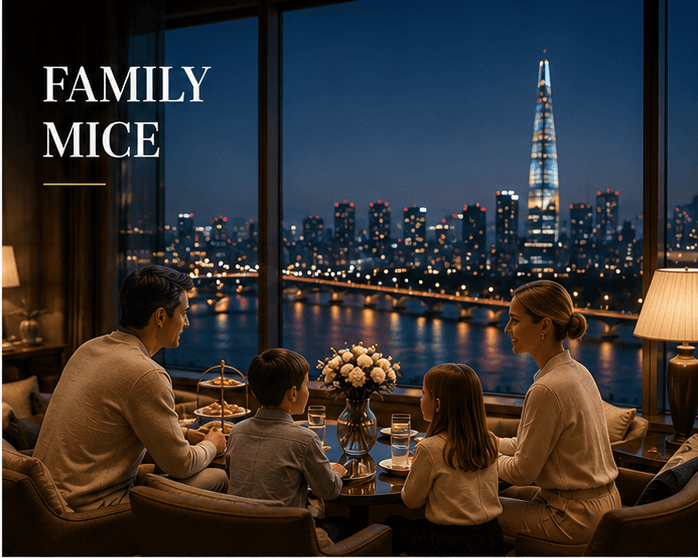
→ Family MICE, human-centered Korea experiences
Personal Reflections Between Seoul, Paris, and Multigenerational Global Culture
Working with internationally minded families over the years, one thing kept repeating. Teenagers and parents were fascinated by Korea for completely different reasons. That difference says something about Korea, and something about modern families.
What Teenagers See
Teenagers come to Korea through K-pop, gaming, fashion, creator ecosystems, beauty trends, digital aesthetics, and Korea’s highly visual youth culture. For young people around the world, Korea feels immediate, expressive and alive.
Korean youth culture moves quickly. It adapts rapidly, and it constantly evolves through digital platforms, visual storytelling and social interaction. Teenagers often engage emotionally first.
What Parents See
Parents are usually looking at something else entirely: education, entrepreneurship, wellness, innovation, consumer behavior, design sensitivity, gastronomy, business ecosystems, and Korea’s extraordinary transformation within only a few generations.
Some parents also quietly recognize deeper emotional layers underneath Korea’s visible surface. They observe pressure, adaptability, discipline, resilience, social hierarchy, identity negotiation, and the emotional complexity shaping modern Korean society.
That layered quality is exactly what makes Korea interesting for globally minded families.
Two Generations, One Country
Different generations can travel through the same country and live in entirely different realities while they do it.
Teenagers are looking for identity, creativity, connection, expression and belonging. Parents are looking for perspective, reflection, education, cultural intelligence, wellness, and some understanding of where global culture is heading.
Traditional tourism structures rarely create enough space for these layered forms of engagement. Schedules become rushed, experiences become generalized, and emotional pacing often disappears.
But perhaps meaningful family immersion does not emerge from forcing everyone into identical rhythms. Perhaps deeper connection happens when each individual is also allowed space, curiosity, personal observation, reflection, and emotionally meaningful engagement through their own perspective.
That became one of the philosophical foundations behind KP Nalgae and the evolving concept of Family MICE and Human-Centered Korea Experiences. Not simply organizing itineraries, but carefully curating immersive ecosystems where teenagers, parents, entrepreneurs and multicultural families may engage with Korea through different emotional and intellectual lenses while still remaining meaningfully connected together.
Because perhaps Korea’s greatest value for global families today lies not only in entertainment or tourism, but in its ability to create multi-layered experiences where different generations may simultaneously discover creativity, identity, reflection, cultural intelligence and human connection together.
→ Read more about Family MICE and human-centered Korea experiences.
Author
Kary Sungmi Park — Paris-based cross-cultural strategist and founder of KP Nalgae.
Related Perspectives
• What Global Parents Often Misunderstand About Korean Youth Culture
• Why Teenagers and Parents Experience Travel Differently
• Korea Beyond K-pop for International Families