Beyond Business Matching
The institutions engaged through this work are listed in the Selected Institutional Portfolio.
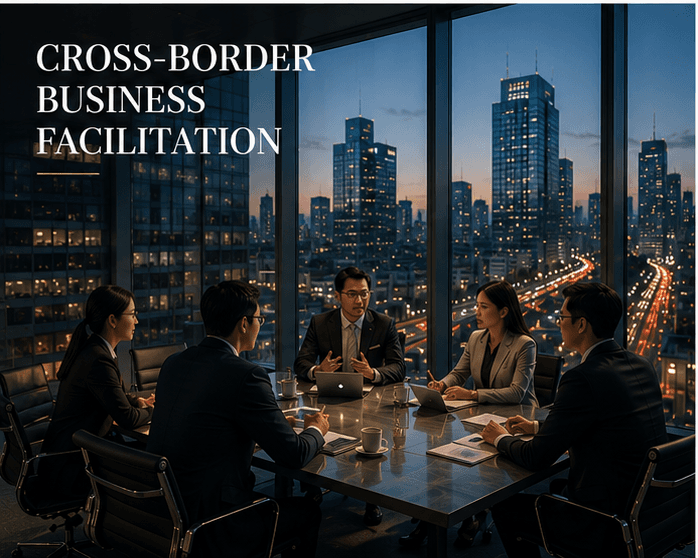
→ Cross-Border Business Facilitation
The Human Architecture Behind Meaningful International Collaboration
In today’s global environment, international access has never been easier.
Information moves instantly.AI generates strategies within seconds.Digital platforms create global visibility across borders almost overnight.
Yet despite this unprecedented level of connectivity, many cross-border collaborations still quietly fail.
Because meaningful international collaboration has never depended on information alone.
It depends on interpretation.
Why Cross-Border Collaboration Requires More Than Access
True cross-border facilitation with genuine business sensitivity is not something developed overnight.
It is far more than simply communicating through a shared language, organizing meetings, or exchanging information.
Meaningful international collaboration often depends on a highly nuanced set of human capabilities:
understanding cultural context
interpreting emotional dynamics
recognizing unspoken expectations
sensing timing
understanding negotiation rhythm
navigating trust-building systems
and recognizing how different societies communicate, position themselves, and make decisions
These are deeply experience-based skills that are difficult to replicate through information alone.
They are cultivated over years of working across cultures, industries, business environments, and human systems.
The Invisible Human Systems Behind International Business
Educated in Canada, and having lived between Korea, Hong Kong, Europe, and now Paris, I have been able to observe how differently cultures approach hierarchy, communication, business relationships, emotional expression, speed, and long-term collaboration.
Some systems prioritize rapid execution.Others move through reflection and structural alignment.Some approach meetings transactionally.Others see meetings as the beginning of long-term trust architecture.
Neither approach is necessarily right or wrong.
But misunderstanding these invisible cultural layers often creates friction beneath otherwise promising business opportunities.
In many ways, facilitation itself is both a strategic and deeply human discipline.
KP Nalgae’s Approach to Human-Centered Business Facilitation
At KP Nalgae, this human layer of international collaboration is treated with great importance and respect.
Our role is not simply to connect people, but to help different worlds understand one another more meaningfully — through cultural intelligence, thoughtful interpretation, strategic observation, and long-term relationship architecture.
For selected clients, KP Nalgae may also help open pathways toward new opportunities through accumulated market insight, cross-cultural experience, trusted networks, and regional understanding developed over years of international exposure.
A broader spectrum of consultation surrounding new market entry, cultural positioning, partnership navigation, business direction, and cross-border opportunity development may also be explored depending on each project’s objectives and long-term vision.
KP Nalgae is not positioned as a large corporate consulting structure.
Rather, it operates as a carefully curated boutique platform focused on creating thoughtful alignment between the right people, opportunities, business environments, and cultural ecosystems.
Why Human-Centered Facilitation Matters More Than Ever
This type of work requires a different layer of preparation beyond conventional networking or transactional introductions.
Clients may expect a more refined form of meeting architecture — one shaped by international experience, cultural interpretation, business sensitivity, and a deeper understanding of how trust and collaboration are built across different environments.
Because ultimately, successful global collaboration is rarely built through access alone.
It is built through trust, clarity, human understanding, and the ability to navigate what exists beneath the visible surface of international business.
→ Read more about Cross-Border Business Facilitation.
Author
Kary Sungmi Park — Paris-based cross-cultural strategist and founder of KP Nalgae.
Related Perspectives
• Why Understanding Korea Requires More Than Translation
• Why Human-Centered Facilitation Matters More in the Age of AI
• The Rise of Family MICE in Global Business Culture